Table Of Content

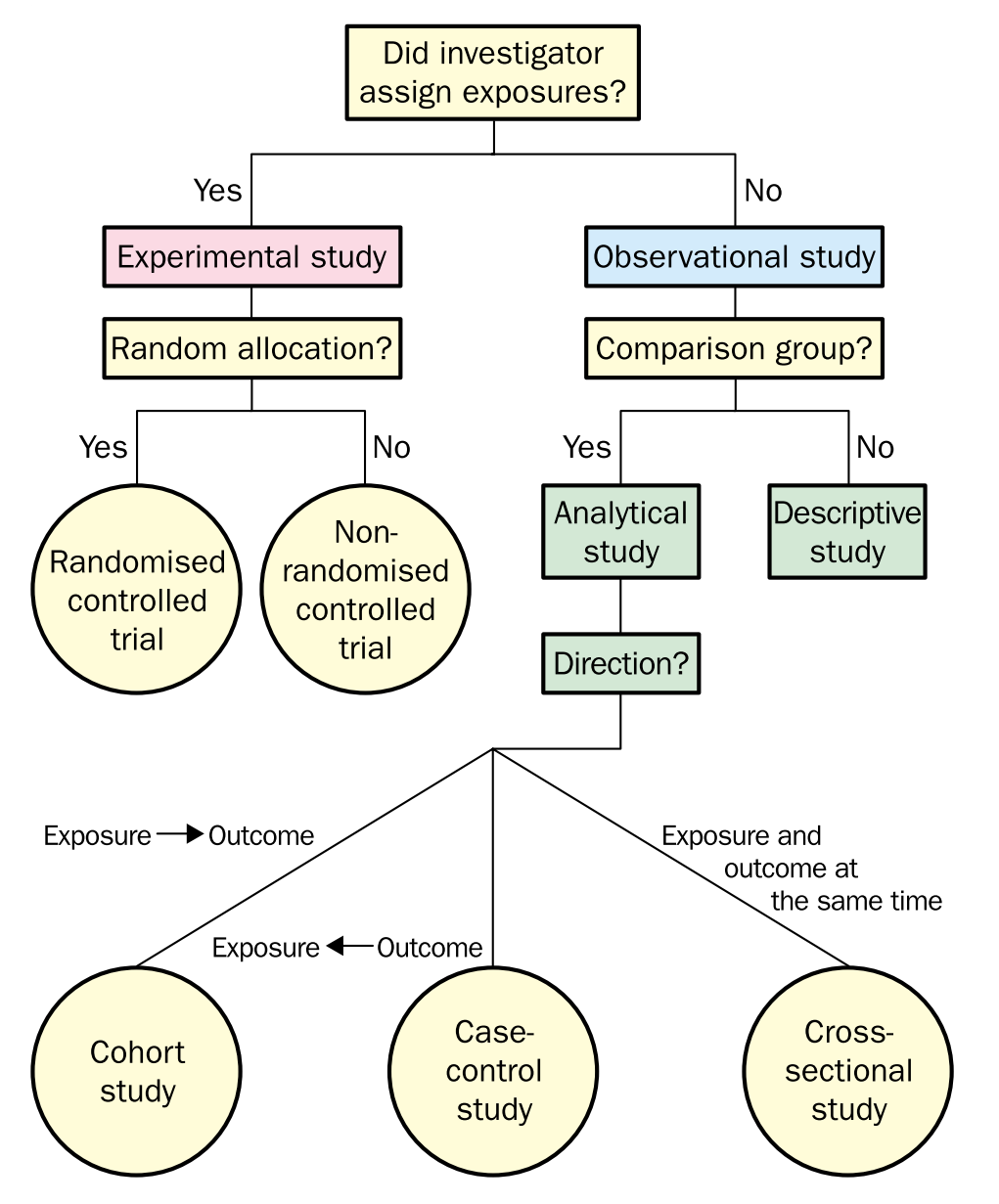
It is less expensive and less time‐consuming than cohort studies (described in section “Cohort study”). An example of a case‐control study was performed in Pakistan evaluating the risk factors for neonatal tetanus. They retrospectively reviewed a defined cohort for cases with and without neonatal tetanus.9 They found a strong association of the application of ghee (clarified butter) as a risk factor for neonatal tetanus.
Code, Data and Media Associated with this Article
It is the most accurate type of experimental design and may be carried out with or without a pretest on at least 2 randomly assigned dependent subjects. A non‐randomized clinical trial involves an approach to selecting controls without randomization. With this type of study design a pattern is usually adopted, such as, selection of subjects and controls on certain days of the week. Depending on the approach adopted, the selection of subjects becomes predictable and therefore, there is bias with regards to selection of subjects and controls that would question the validity of the results obtained. Descriptive observational studies provide a description of the exposure and/or the outcome, and analytic observational studies provide a measurement of the association between the exposure and the outcome.
Article Menu
In simple randomization, the subjects are randomly allocated to experiment/intervention groups based on a constant probability. That is, if there are two groups A and B, the subject has a 0.5 probability of being allocated to either group. This can be performed in multiple ways, and one of which being as simple as a ‘flip of a coin’ to using random tables or numbers.17 The advantage of using this methodology is that it eliminates selection bias. However, the disadvantage with this methodology is that an imbalance in the number allocated to each group as well as the prognostic factors between groups. In a factorial design, participants are randomly assigned to one of several groups, each of which receives a different combination of two or more independent variables. The types of experimental research design are determined by the way the researcher assigns subjects to different conditions and groups.
(PDF) A quasi-experimental study to assess the effectiveness of structured teaching programme regarding BE FAST ... - ResearchGate
(PDF) A quasi-experimental study to assess the effectiveness of structured teaching programme regarding BE FAST ....
Posted: Mon, 04 Mar 2024 08:00:00 GMT [source]
Order effects
The structure design and offshore oilfield experiment study of industrial compact flotation unit - ScienceDirect.com
The structure design and offshore oilfield experiment study of industrial compact flotation unit.
Posted: Tue, 01 Aug 2023 07:00:00 GMT [source]
This could take up to years before development of disease/outcome, and therefore is time consuming and expensive. On the other hand, retrospective cohort studies identify a population with and without the risk factor/exposure based on past records and then assess if they had developed the disease/outcome at the time of study. Thus, the study design for prospective and retrospective cohort studies are similar as we are comparing populations with and without exposure/risk factor to development of outcome/disease. However, the difference between the two is the assignment of the control group.
Formplus - For Seamless Data Collection
Study design is the preferred term in the AMA Manual of Style,2 so I will use it here. We have discussed various clinical research study designs in this comprehensive review. Though there are various designs available, one must consider various ethical aspects of the study. Hence, each study will require thorough review of the protocol by the institutional review board before approval and implementation. Information bias is when a systematic error is committed while obtaining data from the study subjects. This can be in the form of recall bias when subject is required to remember certain events from the past.
Randomly allocating participants to independent variable conditions means that all participants should have an equal chance of taking part in each condition. A matched pairs design is an experimental design where pairs of participants are matched in terms of key variables, such as age or socioeconomic status. One member of each pair is then placed into the experimental group and the other member into the control group. The purpose of this Communications article is to clarify the purpose and placement of study design elements in an experimental manuscript.
Quasi-experimental research is more common in educational studies, nursing, or other research projects where it's not ethical or practical to use randomized subject groups. For instance, if the control group also experiences a change, it reveals that taking the test twice changes the results. With the ability to analyze the relationship between variables and using measurable data, you can increase the accuracy of the result. Surveys can be shared with the respondents both physically and electronically. When collecting data through surveys, the kind of data collected depends on the respondent, and researchers have limited control over it. Data collection methods in experimental research are the different ways in which data can be collected for experimental research.
True Experimental Research Design
Although this suggests a causal relationship, cause cannot be proven by this methodology (Figure 3). In this research design, one or more subjects or dependent variables are randomly assigned to different treatments (i.e. independent variables manipulated by the researcher) and the results are observed to conclude. One of the uniqueness of experimental research is in its ability to control the effect of extraneous variables. For example, assume the goal is to determine the strength gain in novice and experienced athletes as a result of 3 strength training programs. Rate of change in strength is not a measurable variable; rather, it is calculated from strength measurements taken at various time intervals during the training.
Experimental Research: What it is + Types of designs
With a firm understanding of the system you intend to study, you can write a specific, testable hypothesis. Researchers assign the first control group a posttest only and the second control group a pretest and a posttest. This structure requires the researcher to divide participants into two random groups. One group receives no stimuli and acts as a control while the other group experiences stimuli. This method includes two or more groups, enabling the researcher to use one group as a control. Various settings and professions can use experimental research to gather information and observe behavior in controlled settings.
The pre-experimental design will help researchers understand whether further investigation is necessary for the groups under observation. Research study designs are of many types, each with its advantages and limitations. The type of study design used to answer a particular research question is determined by the nature of question, the goal of research, and the availability of resources. Since the design of a study can affect the validity of its results, it is important to understand the different types of study designs and their strengths and limitations. Repeated Measures design is an experimental design where the same participants participate in each independent variable condition.
This also ensures comparability between groups as most baseline characteristics are similar prior to randomization and therefore helps to interpret the results regarding the intervention/experiment group without bias. Experimental design provides a structured approach to designing and conducting experiments, ensuring that the results are reliable and valid. The purpose of experimental design is to control and manipulate one or more independent variables to determine their effect on a dependent variable. Experimental design allows researchers to systematically investigate causal relationships between variables, and to establish cause-and-effect relationships between the independent and dependent variables. Through experimental design, researchers can test hypotheses and make inferences about the population from which the sample was drawn.
If the variation in random errors is relatively small compared to the total variation in the response, we would have evidence for treatment effect. For example, this research is essential for developing new drugs and medical treatments. Researchers can understand how a new drug works by manipulating dosage and administration variables and identifying potential side effects. The way you classify research subjects based on conditions or groups determines the type of research design you should use.
The control group tells us what would have happened to your test subjects without any experimental intervention. Experimental design means creating a set of procedures to systematically test a hypothesis. A good experimental design requires a strong understanding of the system you are studying.
It involves an intervention that tests the association between the exposure and outcome. Each study design is different, and so it would be important to choose a design that would most appropriately answer the question in mind and provide the most valuable information. Cohort studies can be classified as prospective and retrospective.7 Prospective cohort studies follow subjects from presence of risk factors/exposure to development of disease/outcome.
It allows us to test theories, develop new products, and make groundbreaking discoveries. Experiments across all industries and research realms provide scientists, developers, and other researchers with definitive answers. Sometimes, recruiting a sample of people to randomly assign may be difficult. Experimental research design is a scientific framework that allows you to manipulate one or more variables while controlling the test environment. Differences between experimental and non experimental research on definitions, types, examples, data collection tools, uses, advantages etc.
Remember, you should assign one group as a control and use one or more groups to study the effects of variables. Define the independent variable (the intended stimuli) and the dependent variable (the expected effect of the stimuli). After identifying these groups, consider how you might control them in your experiment. The two variable groups mirror the control groups, but researchers expose them to stimuli. The ability to differentiate between groups in multiple ways provides researchers with more testing approaches for data-based conclusions. After researchers presume the stimulus or treatment has caused changes, they gather results to determine how it affects the test subjects.